
China's Missing Bronze Age
The Western Bronze Age lasted from 2500 - 1150 BC. Ancient China never had a bronze age at all.

Rogue Missive #125 | Feb 4, 2026
The more I study Chinese history, the more convinced I become that the modern world holds a deeply mistaken belief about the strength and sophistication of the ancient Chinese economy relative to the rest of the world. This misunderstanding has real consequences for how economists, military professionals, and policymakers think about China’s strategic positioning and potential threat.
One conclusion I have reached repeatedly in recent work (here and here) is blunt but unavoidable: for most of its history, China was roughly one thousand years behind the broader Western civilizations of the Mediterranean and Near East. This gap appears again and again across nearly every material and institutional measure we can apply to the ancient world.
Prior to 523 AD, there are no records of great buildings and architecture in China, either physically or textually.
Art in ancient China was technically rudimentary compared to the West of the same time period.
China has little ancient infrastructure, like ports, breakwaters, aqueducts, amphitheaters, and roads. The infrastructure it did have was rammed-earth construction of less advanced things like canals, just on a massive scale.
The ancient West’s urbanization was roughly 15%, while China was 5%.
China didn’t produce a systematic philosophy with metaphysics and epistemology until approximately 1100 AD, and never produced anything like the Iliad or Odyssey.
Taken together, these gaps already suggest a long-standing gap. But I’ve identified something even more fundamental that supports this framework. China didn’t participate in the Bronze Age.
Bronze In China
When historians speak of a “Bronze Age,” they usually mean more than the mere presence of bronze. They mean a systemic material regime: a period in which bronze becomes the dominant material for weapons, tools, and elite production, reshaping warfare, agriculture, and state power.
By that definition, China never fully experienced a Bronze Age, at least not in the way the Mediterranean and Near East did.
In Egypt, the Near East, and Aegean between roughly 2500 and 1200 BC, bronze became the dominant substrate of civilization. Weapons, tools, and critical implements were increasingly made from bronze, displacing stone and pure copper at scale. This fundamentally altered how societies organized labor, warfare, and power.
The military implications were especially significant. Bronze enabled metal-intensive forms of warfare, like chariots, standardized weapons, and heavily equipped elites, that reshaped conflict and state formation. Control over bronze production and distribution became synonymous with political authority, while access to metal increasingly determined who could project power.
Bronze requires tin, a metal that is both rare and unevenly distributed. As a result, Bronze Age civilizations depended on long, complex, and vulnerable trade networks stretching across land and seas. Tin moved from distant sources through multiple intermediaries before reaching the workshops that sustained armies and states.
This extensive reliance on long distance trade for tin, could be a contributing factor of the Late Bronze Age Collapse around 1200–1150 BC. When trade networks broke down, bronze-dependent societies lost access to a core material input.
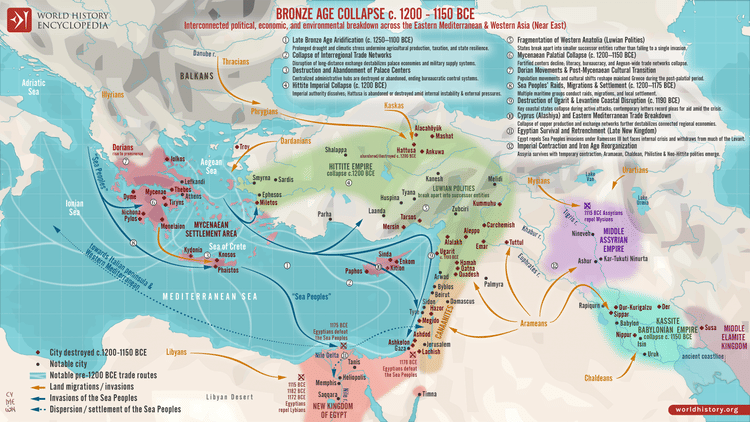
China’s relationship with bronze followed a fundamentally different trajectory. In the Shang dynasty, around 1600 BC, China had sophisticated bronze casting, but it never approached wide-scale adoption across society.
Bronze in China was not deployed as a universal material. In that sense, China never had a true “Bronze Age.” Everyday tasks continued to rely heavily on older materials. Stone, bone, wood, and even pure copper persisted alongside bronze for centuries.
Even during the Western Zhou period, when bronze usage broadened somewhat, it never fully displaced earlier technologies across society. Bronze remained elite, ceremonial, and state-centered rather than a scalable production material. China had bronze, but it did not reorganize civilization around it.
China’s closest approach to broader bronze usage occurs after the Western Bronze Age system in the Mediterranean and Near East had already collapsed.
Access To Tin
Fine bronze is an alloy of approximately 90% copper and 10% tin by weight. Copper Sources of copper were widespread and relatively abundant in the ancient world, but sources of tin were extremely rare. Ancient trade routes for tin stretched thousands of kilometers across harsh terrain and rough seas.
It was this trade in tin that defined “international trade” of the era. Trade in other goods was marginal by comparison. Even at its peak, cross-border trade accounted for a tiny fraction of ancient economy activity, orders of magnitude lower than today.
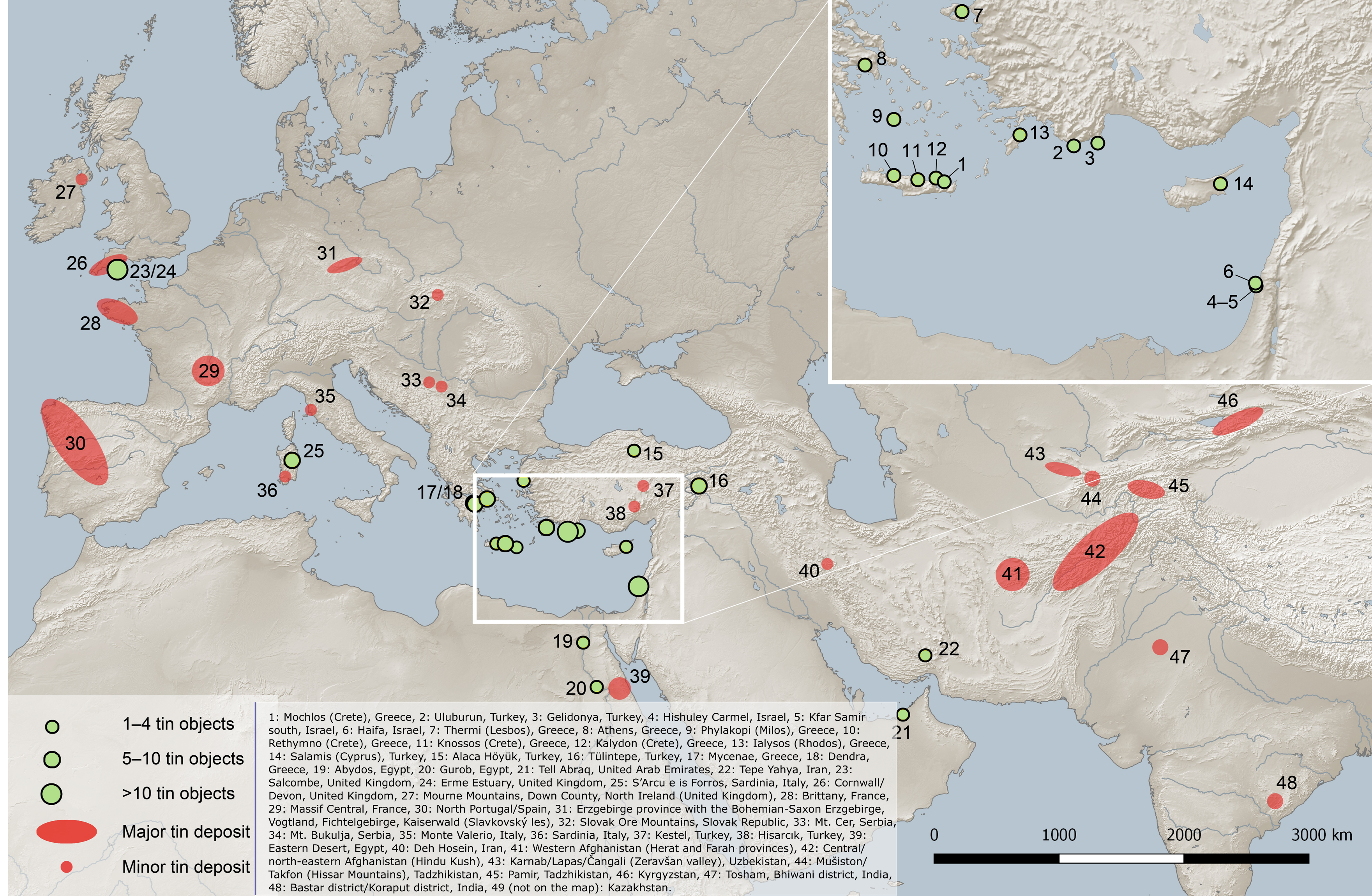
In the modern era of globalization, imports and exports typically make up 10–30% of national economies. In the ancient world, by contrast, economic life was overwhelmingly local: rural, agricultural, and self-contained. Long-distance trade likely accounted for around 0.1% of total economic activity, yet it carried outsized strategic importance because it supplied the single material, tin, on which entire Bronze Age systems depended.
Tin resources were more abundant in China than in the West, yet the West adopted bronze at scale nearly a millennium earlier. On the map above, you can see that there are no significant sources of copper in the Eastern Mediterranean or Near East. The main trade routes ran 2500 km to Badakhshan in modern day Afghanistan, Cornwall in modern England, or Northwest Iberia in modern Spain, to find significant amounts of tin.
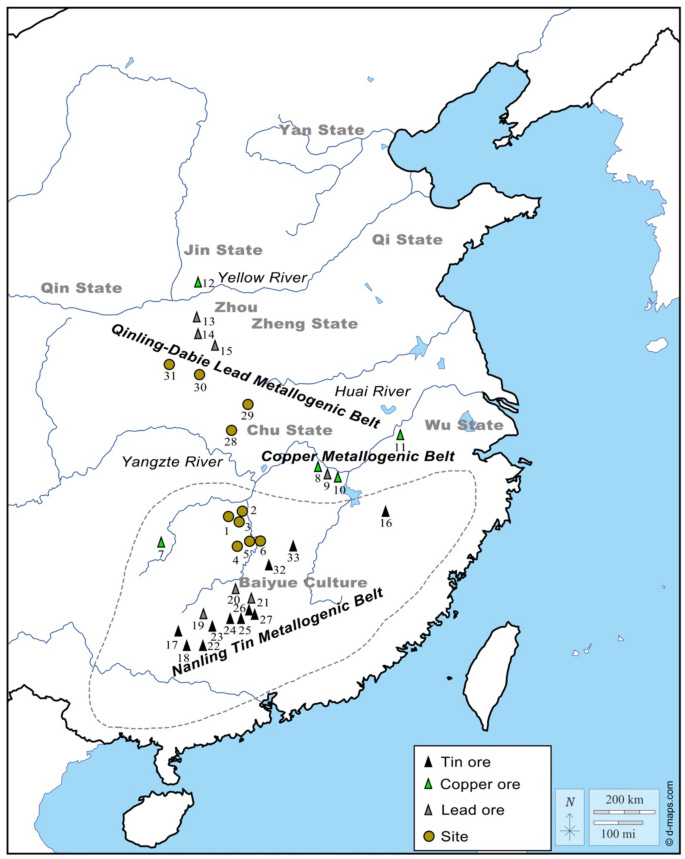
By contrast, China sat near one of the great sources of tin in world history: the Eastern Tin Belt, stretching from Southeast Asia into southern China. The millennia-long delay in China’s adoption of bronze was not the result of a lack of raw materials. Tin was available. The reason is something else.
Some historians have argued that China’s domestic access to tin actually delayed bronze’s widespread adoption. Without the necessity of building long-distance trade routes, China also avoided the social, institutional, and political developments that tend to accompany them. Where the West was forced to organize merchants, contracts, and interstate guarantees to secure tin, China had no such pressure to restructure society around metal production.
I would add another factor. China’s primary mode of competition was largely internal, marked by recurrent domestic conflict and consolidation, rather than sustained interstate rivalry. In such an environment, rulers had strong incentives not to arm the broader population with superior weapons. Mass access to bronze could just as easily empower internal challengers as external enemies. In the West, by contrast, constant competition between rival states rewarded any technological advantage that could be fielded quickly, regardless of its destabilizing effects at home.
Whatever the precise weighting of these causes, the outcome is clear. China enjoyed better access to the critical raw materials of bronze, yet the West achieved wide-scale bronze adoption nearly a thousand years earlier.
Why This Matters
Why does it matter that China did not participate in the Bronze Age? Because it fits into a broader and recurring pattern in history, one that helps explain not only the ancient world, but how modern observers misread China’s trajectory today. Across nearly every material, institutional, and cultural measure we can apply to antiquity, China appears roughly a thousand years behind the broader Western civilizations.
In recent decades, Japan, then the Asian Tigers, and finally China have undergone rapid modernization. China has risen to become the primary geopolitical rival of the United States, leading many analysts to assume it will dominate global affairs over the next century in the same way the United States dominated the last. In my view, this expectation is deeply naïve. China has never historically led the world in economic, technological, or civilizational development, nor has it ever been on sustained parity with the broader West.
Even today, China is not pioneering fundamentally new fields. It has largely adopted Western modes of production, organization, and technology, then scaled them aggressively. This approach is common to centrally planned and communist systems, but it also reflects a much older pattern within Chinese history itself. Where Western civilizations repeatedly pushed into new material, institutional, and philosophical frontiers, China optimized for continuity, control, and volume.
China’s absence from the Bronze Age is not a minor historical curiosity. It is an early, concrete example of a deeper civilizational pattern of internal stability over innovation and scale over sophistication. This pattern did not disappear with antiquity. It remains into the modern era. We should be careful to avoid projecting Western historical trajectories onto China.
Please SHARE with others who might like it!
Follow on X @RogueMacro_
On Youtube