
Human Systems versus Human Action
The metaphysical tension in Mises and the Austrian School leads to a Hayekian extension of the individual
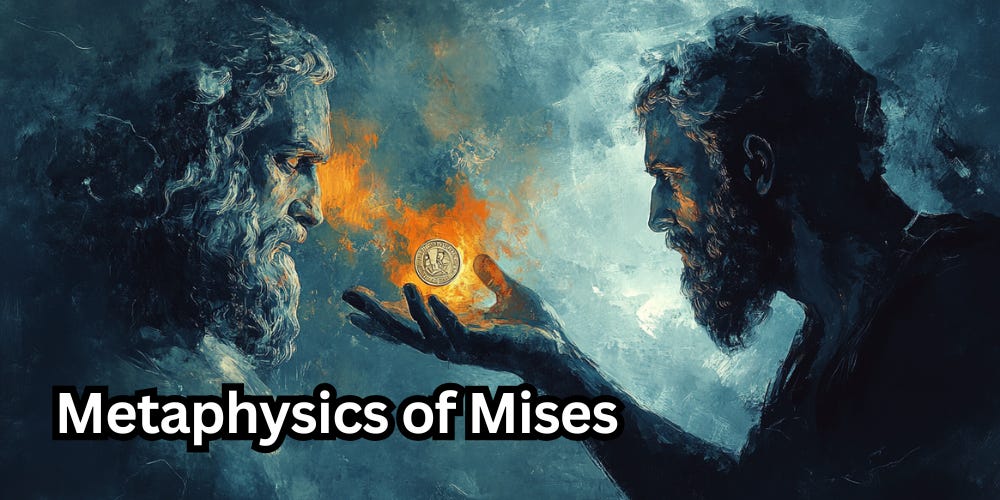
Rogue Missive #122 | Jan 23, 2026
Mises describes the logic of action. I’m trying to describe the ontology of the actor, something he fought against.
Mises’ philosophy is deeply Kantian. Kant argued that there are two “worlds”: the phenomenal world, which is reality as it appears to us after being filtered by the mind, and the noumenal world, reality as it is in itself. We never encounter the noumenal world directly. What we experience is always reality as processed through the mind’s built-in software: categories like space, time, causation, objecthood, and identity.
Kant does not say we live in an illusion; he says we can never know base reality, only reality as it appears after being shaped by the mind. Mises creates a parallel for action. He argues we can only know action (economics) through a priori, built-in software of ends, means, choice, cost, time, and uncertainty. We don’t have access to deeper questions of action, only to how action appears through the lens of these a priori filters. This is summarized in his axiom, “Humans act purposefully, with means toward a chosen aim.”
This is a metaphysical and epistemological claim. The metaphysical claim (What is?) is that reality-as-experienced is always filtered. The epistemological claim (How we know.) is that these filters are a priori, we just know. Together, these moves deliberately subvert any ontological examination of the actor itself. The question “what kind of thing is the actor?” is bracketed out. The individual is treated as the irreducible unit of action.
Mises does this intentionally to make his definition of economics immune to three intellectual threats of his era: psychologism, historicism, and positivism.
Psychologism - Grounding economics in feelings, sensations, associationism, or behaviorism. Economic laws are not stable, they depend on mental states.
Historicism - Marxism is one prominent example. Historicists argued that there are no universal economic laws, only patterns that hold within particular cultures, classes, or historical epochs. Theory becomes a product of time and place.
Positivism (and behaviorism) - Models humans as mechanical systems, reacting to stimuli and governed by statistical regularities, while removing any concern about purpose, intention, and meaning as unscientific. Just bad physics.
Importance of a Reducible Actor
I accept Mises’ logic of action as a grammar of choice. But, as Hayek already pointed out decades ago, this framework is not directly applicable to the real world. Since economics, according to Mises, is a purely logical system of action, anything that precedes action, such as value formation, belief formation, or cultural conditioning, must lie outside of economics. This effectively redefines economics as logic. It is no longer the study of trade, exchange, production, or historical economic systems. It is the study of the form of action.
Praxeology therefore does not replace positivism or historicism. It sidesteps them. You cannot build positivism, Marxism, or any empirical social science on a praxeological foundation; they are methodologically incompatible. But what Mises does not give us in return is a theory of the real economic world as a process unfolding in time. Applying Austrian economics to reality requires what he himself calls “judgment.”
In Mises’s system, the individual mind is the locus of logic. Since economics is defined as a logical system, the individual is, by definition, the irreducible unit. One might say “my hand acts, not me,” but this is ruled out immediately: the hand does not reason, choose, or apply logic. Only the person does.
I do not dispute this at the level of responsibility. The individual is the morally and practically responsible unit of action. But responsibility does not imply simplicity. An entity can be the locus of action while still being the product of a complex causal structure.
What is missing is an ontology of the actor.
Hayek moved partway in this direction. He wrote about cultural evolution, institutions as selection systems, and the distributed nature of knowledge. I am going further. I am claiming that there are multiple real logics operating at different levels: evolutionary logic, genetic logic, cultural logic, institutional logic, environmental logic. The individual is the phenomenological expression of multiple deeper systems. By “phenomenological expression” I mean the form a thing takes as it is experienced in the phenomenal world. In my framework, an individual is biology, instincts, culture, habits, history, and environment interacting together. Phenomenologically, that appears as a person.
The actor is not a primitive. The actor is a phenotype. By “phenotype” I mean the outward manifestation of a thing. A genotype is the blueprint. The phenotype is the building. Individuals are the cells of culture. Groups and institutions are its organs. Memes are viruses. And the environment is the nutrition.
And once the actor is no longer treated as irreducible, history stops being a mystery and starts being a system.
Please SHARE with others who might like it!
Follow on X @RogueMacro_
On Youtube