
Thucydides Trap Or Not?
Debunking one of the most influential geopolitical theories of the modern era.
Rogue Macro | May 20, 2026
Macro systems are human systems. Rogue Macro explores the convergence of economics, biology, geography, politics, and demographics that shape the global economy.
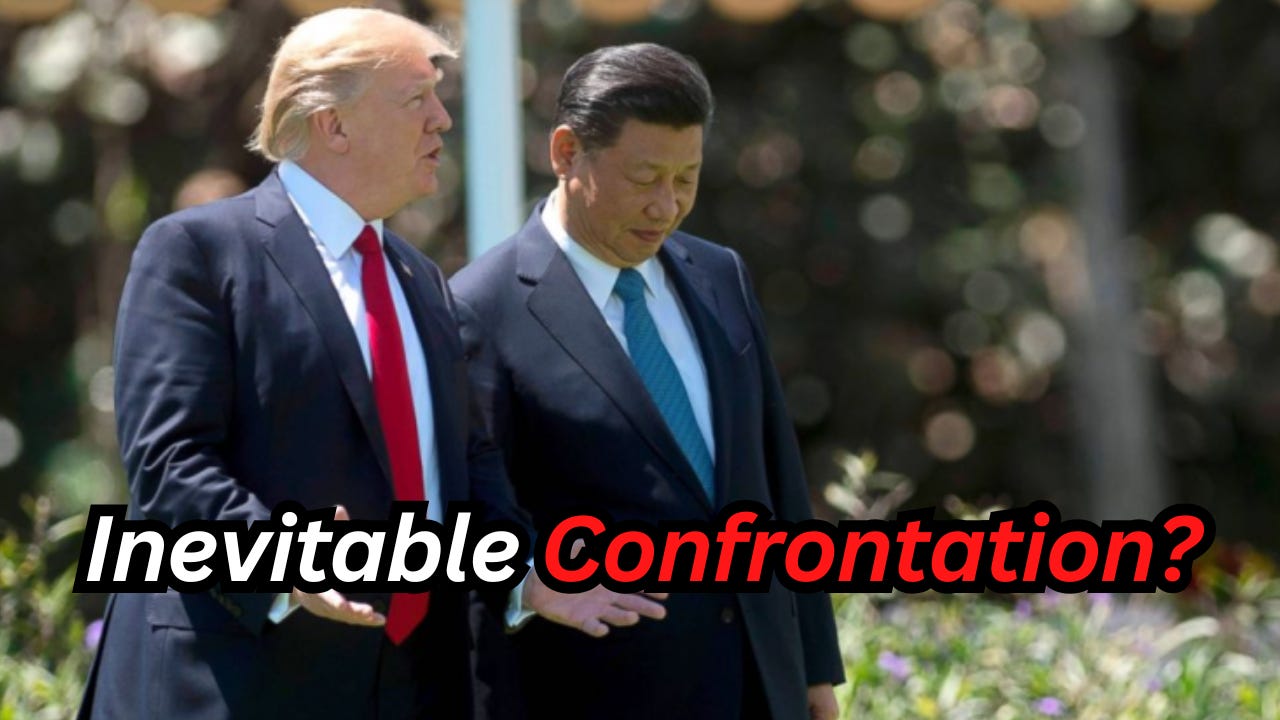
During Trump’s recent trip to China, Xi Jinping explicitly invoked the “Thucydides Trap,” saying it is best for both nations to avoid it. The comment quickly spread online, introducing a whole new generation to the idea that war between a rising China and an established United States may be inevitable.
I first discussed the Thucydides Trap, debunking it on my podcast back in February 2021 and have returned to the topic several times since. But with the concept resurfacing again in public discussion, I thought it was worth publishing the debunk here in Rogue Macro and updating the argument where necessary.
Xi’s 180
Before the meat of the argument, I must address the complete shift in tone from Xi Jinping over the last several years.
2015 (Seattle speech): Xi said, “There is no such thing as the so-called Thucydides Trap”
May 2026 (Trump in Beijing): Xi asked whether China and the US could “transcend the so-called Thucydides Trap and create a new paradigm of major country relations.”
In 2015, the trap does not exist. Today, it exists and we might be able to avoid it. Xi has stressed the non-inevitability of the trap for years, I thought it was important to point out this shift is belief by the Chinese.
The Thucydides Trap Has Fallen From Favor
Back in 2021, when I originally recorded my debunk of the Thucydides Trap, it was very much an outside opinion. The concept was near consensus in foreign policy circles, think tanks, and macro analysis. It had become one of the dominant frameworks for understanding the relationship between the United States and China.
At the time, it was viewed as the educated position to hold. Knowing the concept and agreeing with it signaled that you were a sophisticated geopolitical thinker. In reality, it often meant the opposite. They were all parroting the analogy of Athens rising against Sparta endlessly across academia, policy circles, and the pages of expensive financial newsletters.
But over the last several years, the predicted Chinese overtaking of the United States kept getting pushed further into the future, from 2022, to 2025, to 2028, and eventually perhaps never. At the same time, China’s structural weaknesses became increasingly difficult to ignore. Debt saturation, demographic decline, weak domestic consumption, capital flight, and growing geopolitical resistance all began undermining the narrative of inevitable Chinese dominance.
As a result, the Thucydides Trap has lost much of the momentum and certainty it once carried.
Origins of the Thucydides Trap
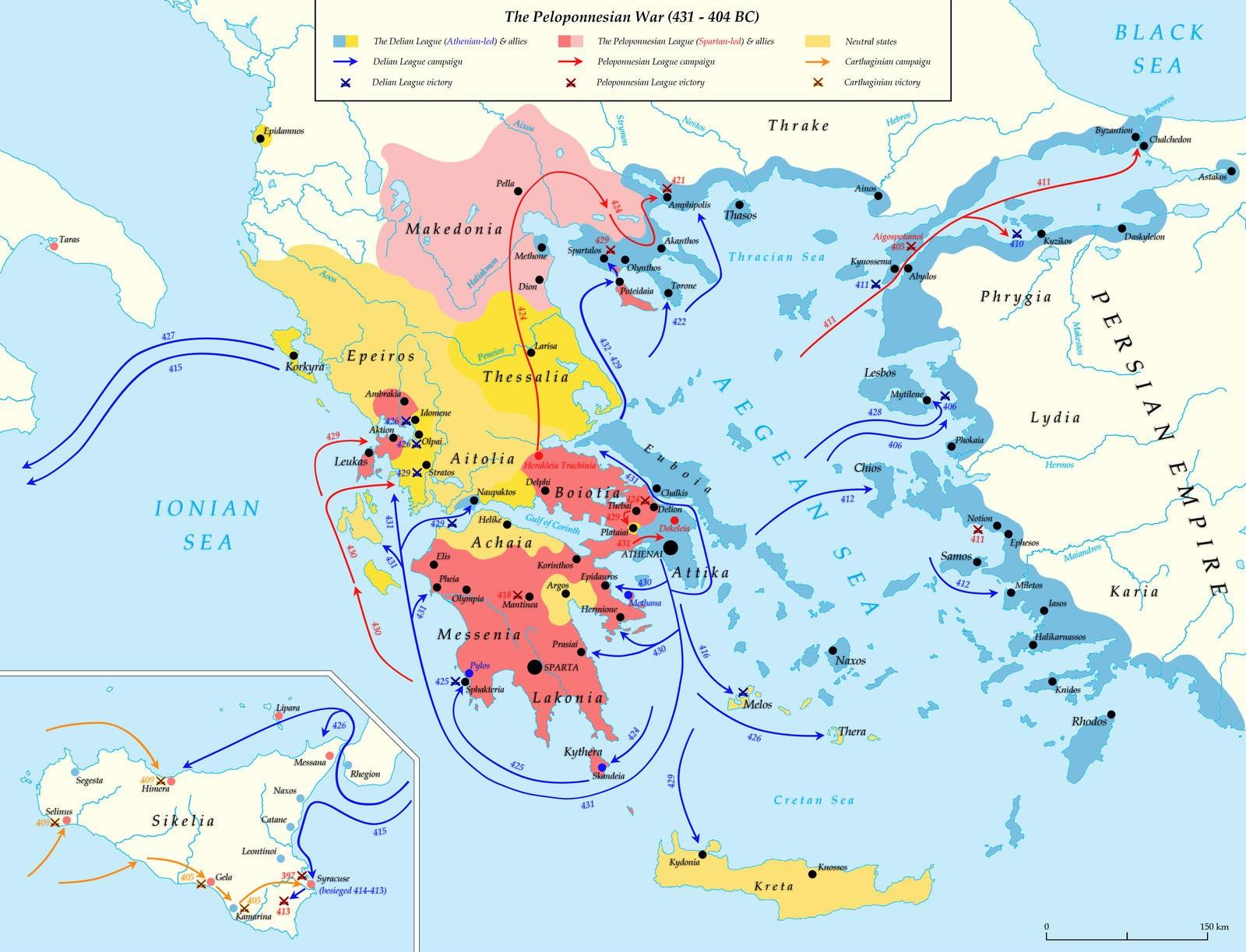
The term is derived from the ancient Greek historian Thucydides and his account of the Peloponnesian War. In 2012, Harvard professor Graham Allison popularized the idea in a Financial Times article titled “Thucydides Trap Has Been Sprung in the Pacific.”
Allison cast China as the rising Athens and the United States as the established Sparta. His argument was that China’s rapid ascent would naturally challenge the U.S.-led order in Asia, what he called the Pax Pacifica, and that history suggested such transitions often end in war.
“It was the rise of Athens and the fear that this instilled in Sparta that made war inevitable.” - Allison
Notice the directionality, it’s the declining power that starts the hostilities because of the feeling of insecurity. Implying rising power is not the aggressor, China is not the aggressor. We’ll see why that’s extremely poor understanding of history.
He pointed to 15 historical cases since 1500 where a rising power challenged a ruling one, arguing that 11 ended in conflict.
It is a compelling narrative. The problem is that it oversimplifies both history and the present.
Japan’s Thucydides Trap That Wasn’t
Several parallels exist between China’s recent rise and Japan’s ascent during the 1980s.
Both experienced debt-fueled growth booms. Both saw corporate liabilities surge relative to GDP, with Japan reaching roughly 150% in the early 1990s and China climbing even higher. Both generated widespread predictions that they would inevitably overtake the United States economically.

Those predictions for Japan did not age well.
China’s economic statistics are also notoriously opaque and difficult to compare directly with Western standards. GDP figures alone often conceal structural weaknesses such as debt dependency, demographic decline, industrial overcapacity, and weak domestic consumption.
More importantly, like Japan before it, China’s rise was heavily driven by investment and exports during a historically unique period of global integration. The post-World War II international system, secured largely by American naval and financial dominance, created the conditions for export-led Asian growth.
In many ways, China did not rise against the American-led order. It rose within it.
A Strong Rebuttal From Arthur Waldron
In 2017, scholar Arthur Waldron published a sharp critique titled “There Is No Thucydides Trap.” Waldron, a respected historian of China and military affairs, argued that Allison’s interpretation badly misreads both Thucydides and the historical record.
Waldron notes that major classicists such as Donald Kagan of Yale and Ernst Badian of Harvard demonstrated long ago that Thucydides did not present the Peloponnesian War as a simplistic case of a fearful established power attacking a rising rival.
Athens was not an innocent commercial power peacefully rising in the system. It had become increasingly aggressive and imperial.
Sparta, contrary to the popular retelling, did not eagerly seek war. It preferred stability and simplicity and was pushed toward conflict largely through pressure from allies such as Corinth. In the end, Sparta won the war.
Waldron also points out that many of Allison’s historical examples do not support the idea of incumbents launching preventive wars out of fear.
Japan attacked Russia in 1904 and attacked the United States in 1941. Germany rose rapidly in the 1930s, but Britain and France did not launch preemptive wars against it. In many cases, the rising power itself acted aggressively.
Waldron warns that Allison’s framework risks encouraging appeasement by portraying aggressive behavior as an unavoidable byproduct of rising power rather than a series of political choices.
Military and Geopolitical Reality
From my own military experience and analysis, China faces severe structural limits.
Although China has rapidly expanded its navy, it’s mostly coastal (“brown water”) or shipping related, not true blue-water capable of sustained operations far from home. True blue-water naval dominance requires overseas logistics, allied basing networks, carrier experience, replenishment capability, secure energy flows, and decades of operational experience.
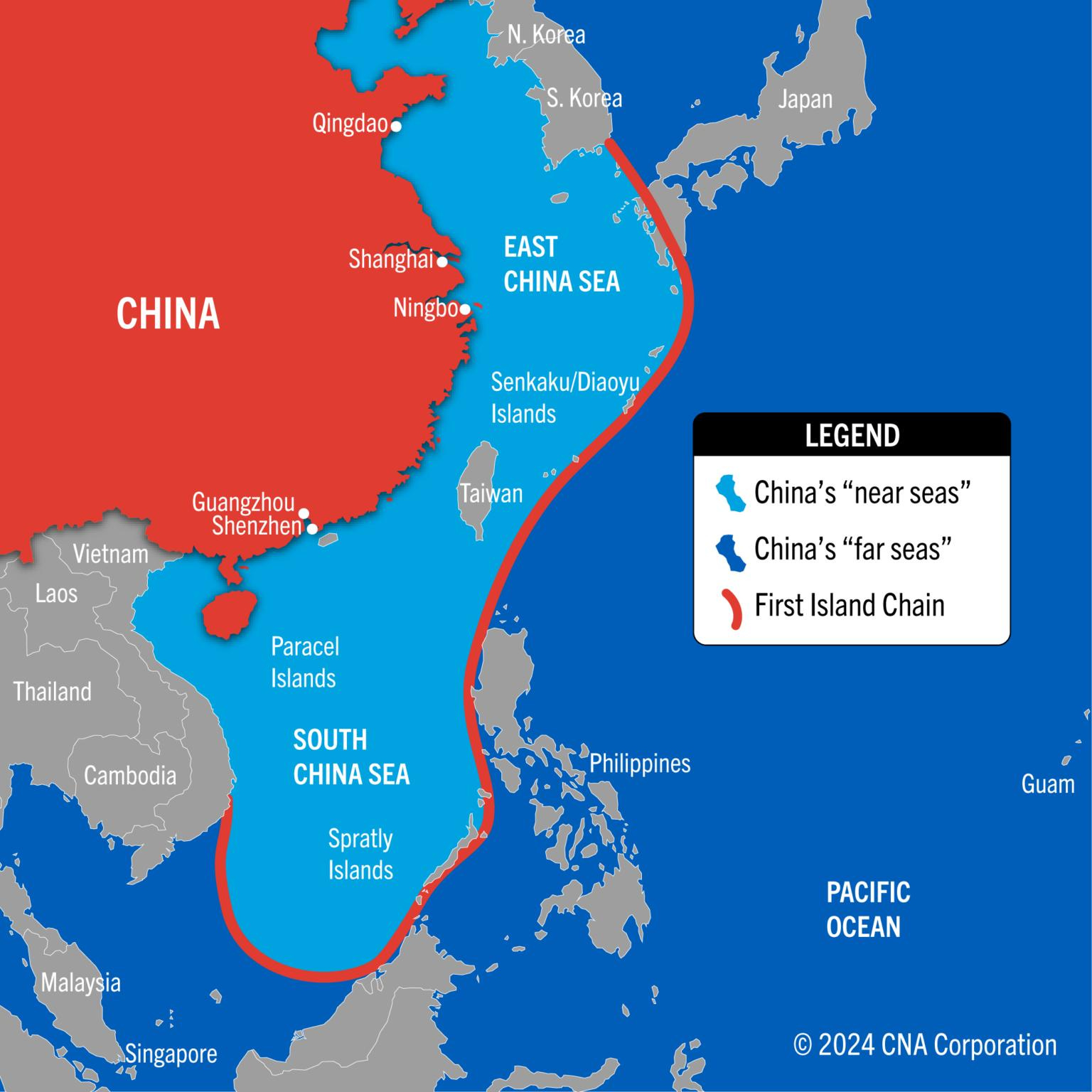
China also remains deeply dependent on imported energy and maritime trade. China imports ~50% of its energy and relies heavily on open sea lanes. This creates a major strategic weakness for a nation whose economy is still overwhelmingly dependent on manufacturing and exports.
At the same time, China’s neighbors are increasingly balancing against it. Japan, India, Vietnam, the Philippines, South Korea, and others continue expanding military cooperation and defense spending. Japan retains deep naval expertise and critical geographic positioning, while India represents a massive long-term continental counterweight.
Projecting power beyond the first island chain, particularly toward Taiwan, would require not just military capacity but the ability to sustain prolonged operations under economic and naval pressure from multiple directions. The United States still maintains major technological, logistical, and alliance advantages in this environment.
China also faces a major economic constraint that receives far less attention than military comparisons. Its domestic consumption remains exceptionally weak relative to the size of its economy, leaving the country heavily dependent on exports and industrial overcapacity. If the United States significantly reduces its trade deficit over time through reindustrialization and reshoring, there is no replacement consumer market large enough to absorb China’s export surplus at the same scale. Therefore, China’s economic model is nearing terminal disruption.
China could redirect this excess industrial capacity toward military production. However, military expansion itself carries enormous long-term costs. Large naval fleets, fighter aircraft, armored vehicles, and overseas operations require constant maintenance, training, logistics, and energy inputs. Sustaining a military-industrial buildup across multiple potential fronts could become economically disastrous, especially in a slowing and aging society.
Drones and lower-cost asymmetric systems may offer China a more sustainable path than attempting to replicate the full global military architecture of the United States.
Final Thoughts
The Thucydides Trap makes for compelling headlines, but in reality it’s arbitrary pro-China propaganda. The world is more complicated than the idea of inevitable conflict between a rising China and an established United States.
The neat framework is not supported by history, and rising powers typically are the ones to start the hostilities. Geography plays a much more decisive role in the development and inevitable problems faced by great powers. There’s no sign that China will become a great expeditionary power to rival the United States.
China faces serious structural challenges including demographic decline, debt saturation, weak domestic consumption, and heavy dependence on global trade routes. Its authoritarian Communist system also creates economic drags and effect how well it can handle periods of decline. Communism is not compatible with durable great power status.
China’s rise also occurred within the very U.S.-led global system it now seeks to challenge. Its export-driven economy depends heavily on exports and global demand, which was the backbone of the old, postwar international order.
Its trajectory will ultimately resemble Japan’s far more than a new hegemon replacing the United States.
ROGUE MACRO - Signal over noise. Predictive power over ideology.