
Top 3 Problems Facing China
Why China’s shrinking population, export dependence, and Taiwan tensions will reshape the next decade

Rogue Missive #129 | Feb 26, 2026
China is a big place. It has a long historical tradition, contains nearly 20% of the human population, and produces close to 30% of global manufacturing output. Its meteoric rise over the past 40 years, from poor to middle-income industrial power, convinced everyone from laymen to think-tank bros that it was an unstoppable force.
However, China today is facing its most trying time since opening up in 1978. The old globalized order characterized by extending supply chains, outsourcing labor, and free flow of finance is ending, and is being replaced by near-shoring or on-shoring, domestic workers, and trade barriers.
China’s economy is a well-oiled machine, for sure, but one built for the previous international order. The world is changing, and China now faces structural pressures that will define the next decade. Here are the Top 3.
Fertility Collapse
Any serious analysis of China must start with fertility.
There are still some who dismiss collapsing birthrates as a manageable issue — something technology or policy can fix. But that view is fading. Economists and futurists increasingly recognize demographic decline as a structural headwind for the next several decades.
Technologists should be paying attention as well. Because this is not just a labor problem. It is a demand problem.
China’s demographic picture is among the most concerning in the world. South Korea may hold the record low at 0.68, but China is not far behind. Its national fertility rate is roughly 0.97, and all large urban regions are significantly below 1.0. Shanghai is 0.61.
The calculation on the image below, showing a population decline of 72% at current levels is misleading. Rates are continuing to fall.
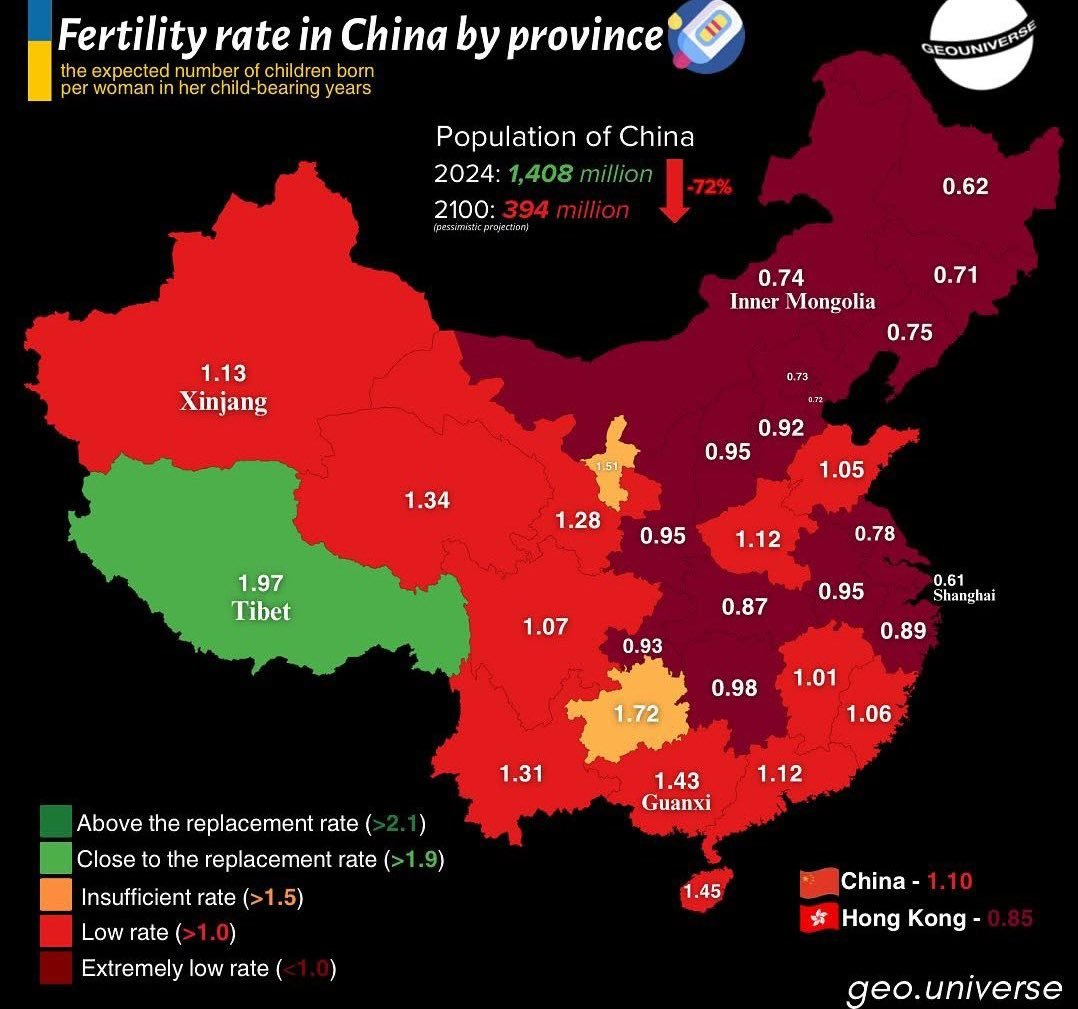
There is also a male slant in the sex ratio of approximately 10%. Replacement fertility rates assume a more even sex ratio. Normal sex ratios about 1.05 males for every female, due to higher mortality rates for boys. This is why replacement fertility is above 2.0. Out of 205 people there will be 105 boys and 100 girls. One hundred women will need to replace 205 people. Adding a slight addition for female mortality, and we get ~2.1 children per women to replace each person.
China has 110 men for every 100 women. Before adding in the small addition for female mortality, the number is already 2.1. We are left with the replacement rate in China being north of 2.1, probably closer to 2.15-2.2.
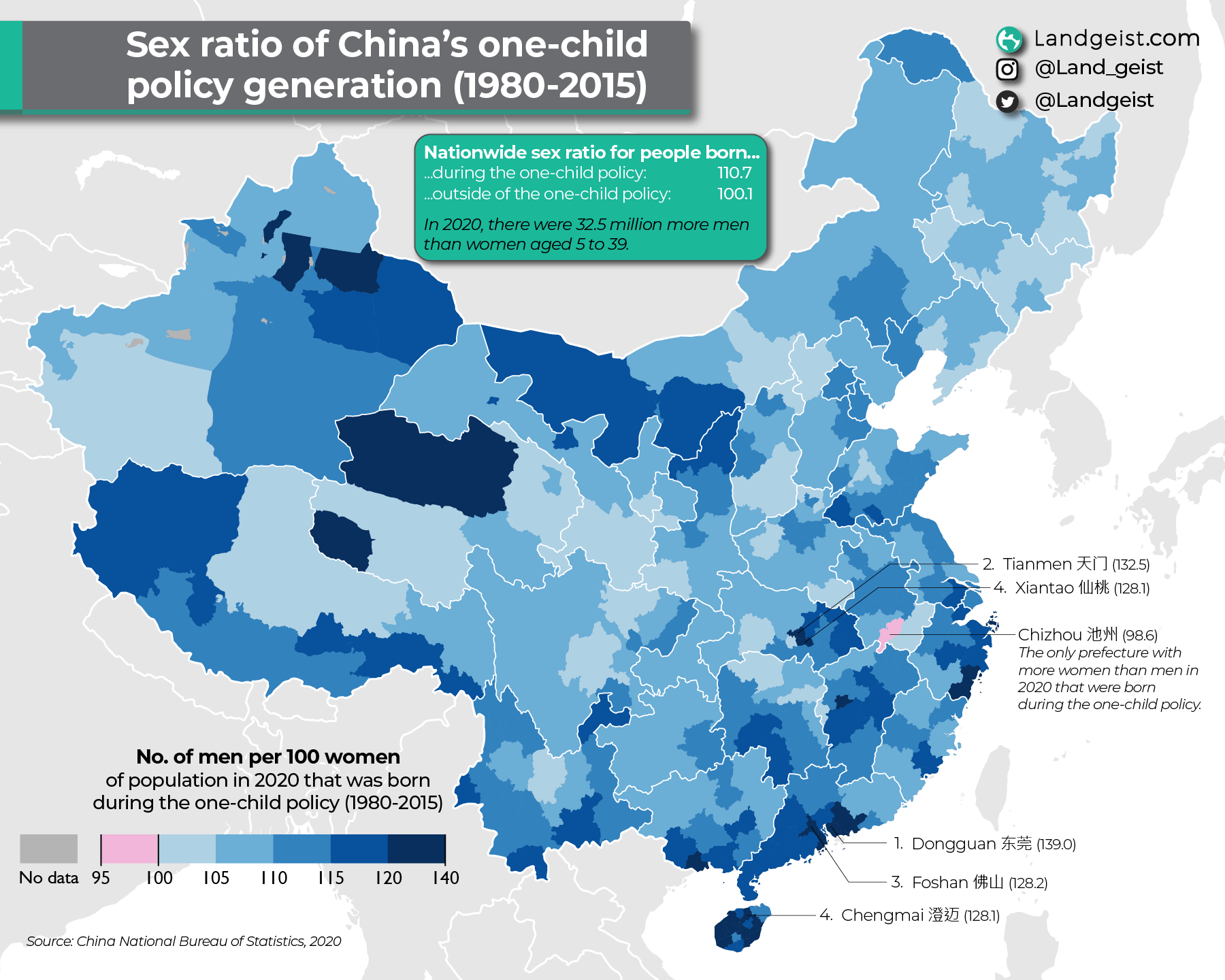
To get a handle on what this means, we can use my Generation Multiplier. This is simple the Total Fertility Rate (TFR) divided by the replacement rate. In China’s case we can write it like this:
China’s Generation Multiplier = 0.97/2.15 = 0.45
We can now use this to see relative size of generations. One hundred Chinese today can expect to have 45 kids (100*0.45). Those 45 produce 20. Those 20 produce 9. That’s if fertility rates don’t continue to worsen, which they look likely to do.
Why does this matter? The reflexive answer to demographic collapse is automation and AI. But robots do not form households. They do not buy apartments. They do not pay income taxes. They do not fill schools or drive durable goods demand.
Already China suffers form a housing glut, with a conservative estimate of 65 - 90 million unoccupied units. This is despite 74% of households in first- and second-tier cities already owning more than one property, and 20% owning three or more. The methodology is not clear if these second and third units are counted as occupied. The situation could be much worse.
Who is going to live in all those ghost city high rises when each generation is less than half the size of the previous one? Who is going to pay taxes? Robots don’t need apartments and don’t pay taxes.
Cities with the most educated people in China, Shanghai and Beijing, have the lowest fertility rates. Meaning it’s likely the most talented people are having the fewest babies. As population shrinks the most productive cohort is shrinking fastest. Fewer inventors, fewer scientists, etc.
Economic Structure, Lack of Domestic Consumption
The United States also has below-replacement fertility. But it has four buffers China lacks:
A large millennial cohort
Higher current fertility (~1.6)
Is an immigration destination
And a consumption share near 65–70% of GDP
China has none of those.
In 2025, China reported roughly 7.9 million births and 11.3 million deaths, a loss of nearly 3.9 million people in a single year. That’s already about −0.24% annual population decline.
If births drift toward 6–7 million over the next decade while deaths rise toward 13–15 million as the population ages, annual decline could reach 7–8 million people, roughly −0.5% per year.
Moreover, it’s not just the absolute population. The deeper issue is age composition. Retirees don’t consume like young workers starting out in life. The highest-consuming cohort in most economies is roughly 25–54 years old. Once individuals move into the 65–74 bracket, consumption typically falls 15–25%. Over age 75, it falls 30–40%.
That’s compression from two sides;
Fewer people overall
Lower per-capita spending within the population
If population declines 0.5% annually, and aging reduces per-capita consumption another 0.5–1% per year, the result is a 1–1.5% structural drag on total household consumption.
China already is starting from a terrible domestic consumption problem. That’s why they export so much. These numbers are very likely going to be fatal to their economic model.
The Chinese government is well aware of this fact. Its economic model depends on external demand absorbing surplus production. And this brings us to import/export math. Global imports and exports must net to zero. If the US gets rid of their trade deficit, that’s $1 trillion fewer global imports, meaning global exports have to shrink by $1 trillion. Unless another country willingly absorbs that deficit, global export capacity must shrink.
China, would ideally, like to pivot toward domestic demand to absorb its production, but demographic contraction makes that pivot structurally constrained.
Japan, Taiwan, and the Mandate of Heaven
The concept of the Mandate of Heaven (天命) predates the modern Chinese state by nearly three thousand years. Under the Zhou dynasty, political legitimacy was not permanent or divinely guaranteed. It was conditional. Heaven granted authority to rulers who maintained order, prosperity, and stability. When famine, corruption, stagnation, or disorder prevailed, the mandate was considered withdrawn. Rebellion and restoration was a duty.

That civilizational logic never disappeared. The modern Chinese Communist Party does not speak in the language of Heaven, but it governs under a similar implicit contract: the Party delivers rising prosperity and national strength; the people deliver compliance and cohesion.
For four decades, that bargain worked. Hundreds of millions were lifted out of poverty. Urban skylines multiplied. Infrastructure spread across the country. Manufacturing scale expanded until China became the industrial center of the world.
Reunification has also been an explicit part of the modern nationalist narrative. Hong Kong was politically consolidated. Taiwan remains unresolved.
When growth was running at 8–10% annually, patience was easier to sustain. Rising living standards softened unresolved questions. But when growth slows and demographics compress, symbolic issues gain weight.
The Mandate of Heaven in modern form rests on performance. If prosperity slows materially, legitimacy must be reinforced elsewhere, through national strength, territorial integrity, and geopolitical posture. The pressure is rising.
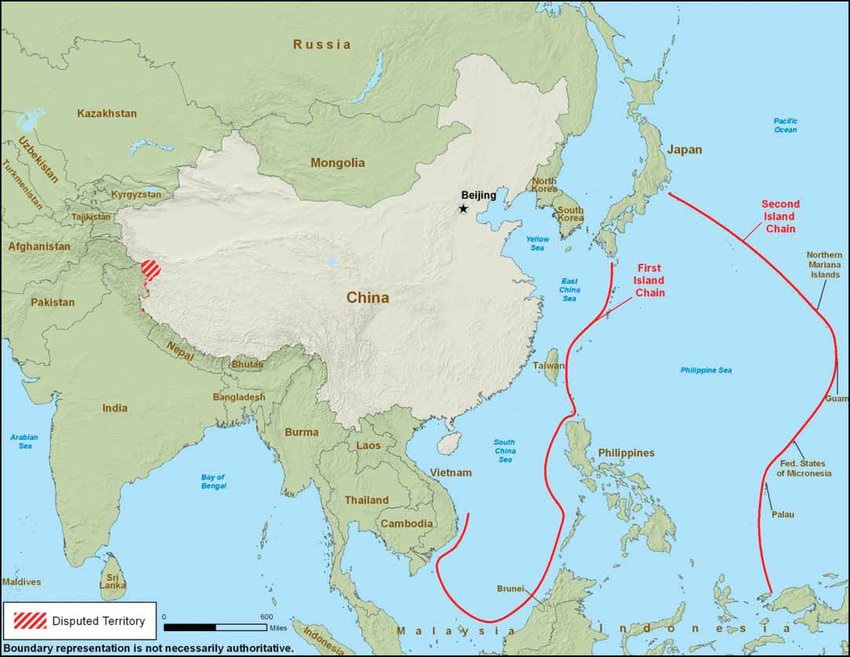
Japan has strong geopolitical interests in Taiwan and they’re beginning to talk tough with a supermajority conservative government. They are rearming as we speak, applying more pressure to Beijing.
Japan has demographic pressures of their own. Surprisingly, they are less acute than China’s. They are shrinking and aging, too, but have spent 30 years improving their domestic consumption. Their economic model is much more stable, and they don’t have an implied mandate to necessarily do anything specific.
Whatever happens, China’s economic model will not work in the future of deglobalization and demographic decline. These are the Top 3 problems.
Allow some geopolitical forecasting at the end here. If Beijing were ever to consider using force to resolve Taiwan, demographic and economic trends suggest that its relative window of maximum leverage is earlier rather than later. As China ages and growth slows, fiscal and military flexibility decline. Meanwhile, Taiwan’s defenses and its external partnerships continue to strengthen.
PLEASE LIKE AND SHARE!
Follow on X @RogueMacro_
On Youtube